
01
Medieval foundation
An almshouse originally formed part of the great religious houses of the Middle Ages, where charitable donations and hospitality were offered to visitors, the poor, vagrants, pilgrims and travellers.
History
St Mary’s is a remarkable surviving example of a 13th-century hospital, still in use today as a Christian foundation providing homes for residents.
Medieval hospitals served the needs of the sick, the poor and travellers. They were concerned with spiritual wellbeing as well as medical care.
Although its role has changed more than once in 800 years, St Mary’s remains rooted in hospitality, community and Christian care.
An almshouse originally formed part of the great religious houses of the Middle Ages, where charitable donations and hospitality were offered to visitors, the poor, vagrants, pilgrims and travellers.
St Mary’s Hospital has existed on its present site since the end of the thirteenth century; not as part of a religious order but as an independent Christian foundation.
Supported by endowments and benefactions, by the middle of the sixteenth century the hospital catered for permanent residents rather than temporary visitors.
From the beginning of the twentieth century until early 2018, the Dean and Chapter of Chichester Cathedral were the Trustees of the hospital and its endowments. The charity’s scheme was then amended to bring in a number of independent Trustees with relevant experience to take the charity forward, whilst retaining three of the original Cathedral Trustees.
Residential accommodation has been progressively improved and increased. Four cottages were converted into almshouses in 1905 and later into three flats plus a guest room; in 1986 St Mary’s Lodge provided a further twelve flats; and in 2003 St Mary’s Courtyard added six flats, a guest flat, a staff bedsit, offices and a communal meeting room. Four more flats have been created from former staff and rented accommodation.
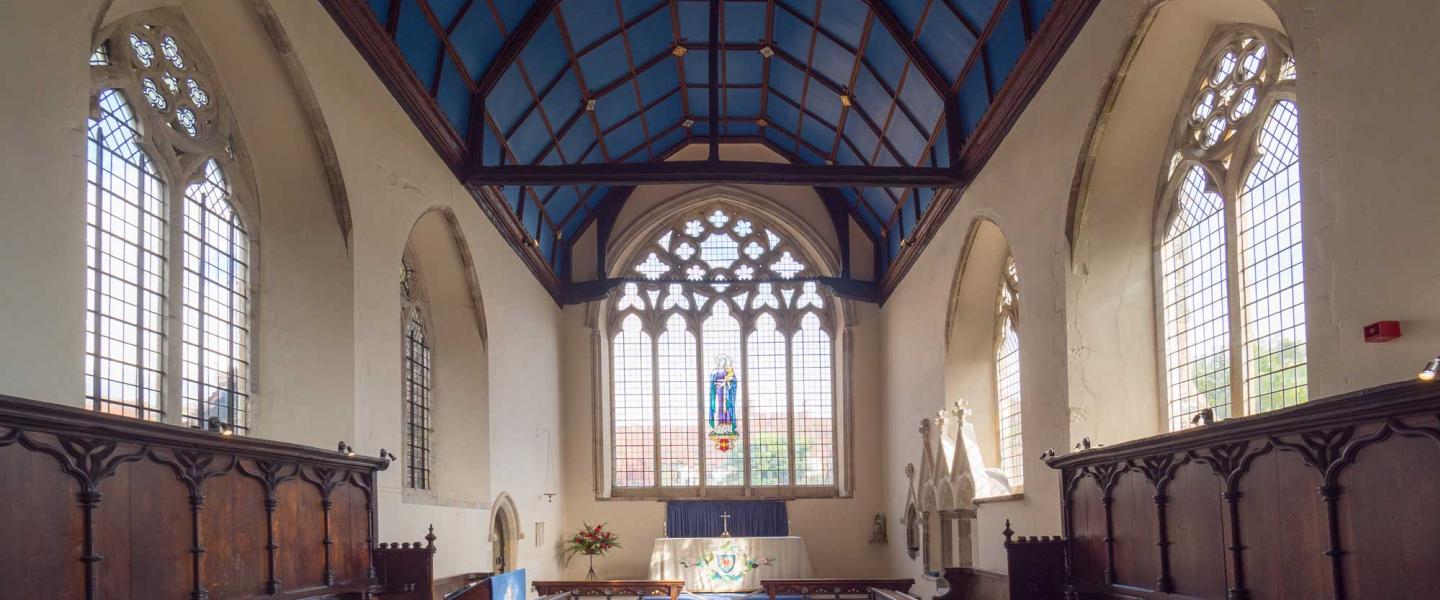
The hospital interior is notable for its timber construction, particularly its roof, and for the chapel attached to it. The wooden stalls in the chapel contain some fine misericords, similar to those in the choir at Chichester Cathedral.
The Trust also owns a portfolio of residential and commercial properties in and around the city, the rent of which is used to run and maintain the almshouses.